Latest Design Trends in Temperature and Humidity Control for Semiconductor Plants
- Share
- Issue Time
- Mar 10,2026
Summary
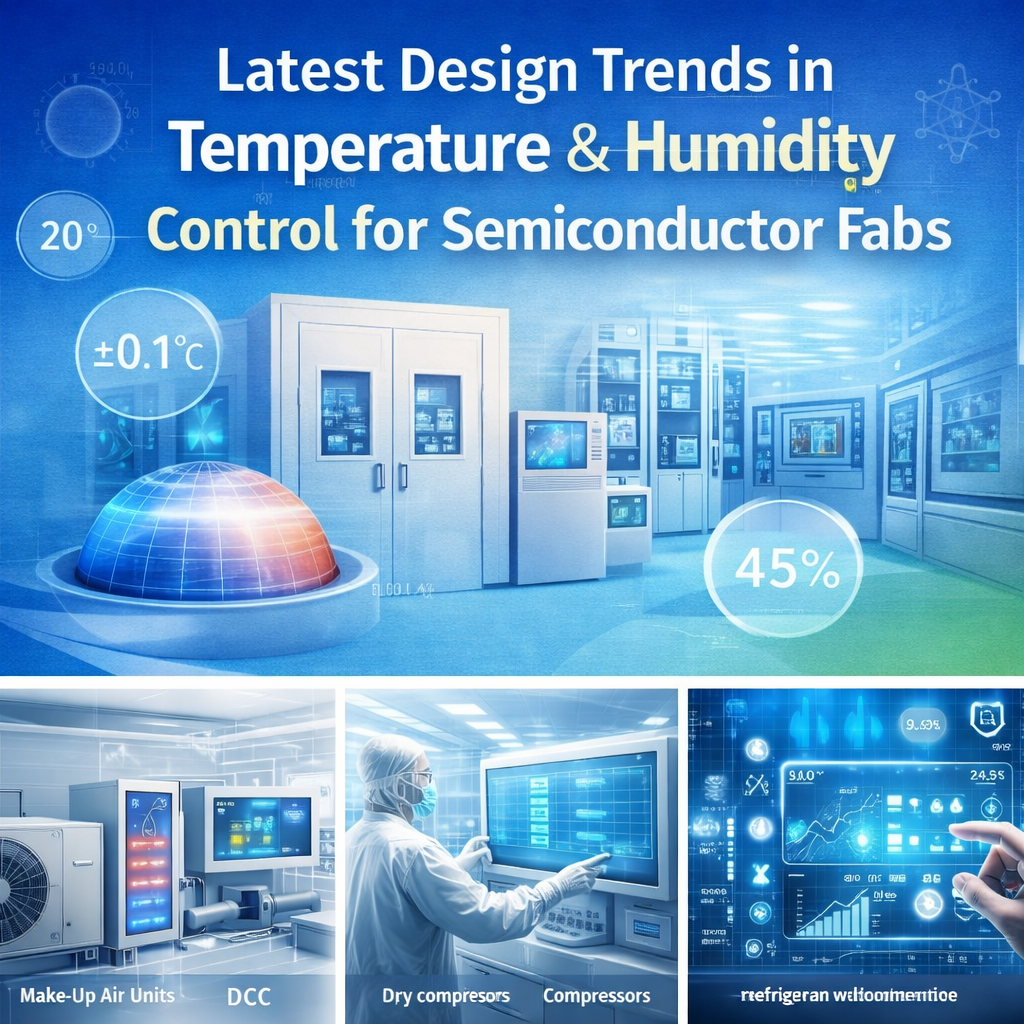
Semiconductor fabs require extremely precise temperature and humidity control to ensure process stability and product yield. This article explores the latest HVAC design trends for semiconductor cleanrooms, including precision environmental control, energy-efficient systems, and intelligent monitoring technologies.
Introduction
Semiconductor manufacturing is one of the most environmentally demanding industrial processes in the world. From photolithography and etching to wafer cleaning and packaging, every stage of chip production requires extremely stable temperature and humidity conditions to ensure product quality and yield.
Even slight environmental fluctuations can affect wafer dimensions, photoresist performance, or equipment alignment. In advanced semiconductor processes, temperature deviations as low as 0.1°C can lead to nanometer-level overlay errors, impacting production yield.
As semiconductor technology continues to advance towards smaller process nodes, the HVAC systems in semiconductor wafer fabs are also rapidly evolving. New designs focus on precise environmental control, energy efficiency, and intelligent monitoring to meet the stringent requirements of modern chip manufacturing.
Environmental Requirements in Semiconductor Cleanrooms
Ultra-Precise Temperature Control
Temperature stability is crucial for semiconductor processes, especially in photolithography.
Typical environmental specifications include:
● Temperature: 20–24°C
● Precision control: ±0.1°C
● Advanced photolithography: Precision up to ±0.05°C
Such high precision prevents wafer expansion or contraction and ensures alignment accuracy during exposure.
To achieve this stability, semiconductor wafer fabs typically employ multi-zone temperature control systems combined with high-precision sensors and advanced HVAC control algorithms.
Stable Humidity Control
Humidity control is crucial in semiconductor manufacturing.
Typical humidity requirements include:
● Relative Humidity: 40–50% RH
● Stability Tolerance: ±1–3% RH
Insufficient humidity can lead to electrostatic discharge (ESD), damaging sensitive semiconductor structures. Conversely, excessive humidity can cause corrosion or affect photoresist materials used in lithography processes.
Therefore, modern semiconductor cleanrooms rely on precision humidification and dehumidification systems integrated into the heating, ventilation, and air conditioning (HVAC) system.
Latest HVAC Design Trends for Semiconductor Temperature and Humidity Control
1. Zoned Environmental Control Systems
Modern semiconductor manufacturing plants are large-scale operations, with different process zones requiring varying environmental conditions.
To address this, designers are increasingly employing zoned HVAC systems to provide independent environmental control for different areas of the cleanroom.
For example:
● Photolithography area: Ultra-precise temperature and humidity control
● Etching area: More stringent chemical contamination control
● Packaging area: Slightly more lenient environmental requirements
Zonedted HVAC systems can improve operational efficiency while maintaining process stability.
2. Integration of MAU + DCC Cleanroom Cooling Architecture
Common HVAC architectures in semiconductor wafer fabs include:
Main Air Units (MAUs)
Provide fresh air, dehumidify, and filter it before it enters the cleanroom.
Dry Cooling Coils (DCCs)
Remove sensible heat from process equipment while preventing condensation on the cooling coils.
This architecture enables precise temperature control and maintains stable humidity levels throughout the cleanroom.
3. Ultra-High Airflow and Laminar Flow Systems
Cleanrooms rely on vertical laminar airflow systems to remove particles and maintain clean environments.
Typical airflow characteristics include:
● Air changes per hour: 300–600 ACH
● Vertical unidirectional airflow from ceiling to floor
● HEPA or ULPA filtration systems
These airflow systems continuously flush particles away from sensitive wafer surfaces while maintaining stable temperature and humidity conditions.
4. Energy-Efficient HVAC Design
Semiconductor cleanrooms are among the most energy-intensive building types, with HVAC systems consuming a significant portion of the facility's energy.
Recent HVAC design trends focus on the following aspects:
● Heat recovery systems
● Natural cooling technology
● High-efficiency chillers
● Energy-efficient airflow management
Studies show that under certain climatic conditions, optimized cleanroom HVAC systems employing heat recovery and natural cooling technologies can achieve energy savings of up to 33%.
5. Intelligent Environmental Monitoring Systems
With the rise of smart manufacturing and Industry 4.0, semiconductor wafer fabs are increasingly reliant on advanced monitoring systems.
Key technologies include:
● Continuous particulate matter monitoring systems
● AI-based HVAC control algorithms
● Real-time environmental sensors
● Predictive maintenance platforms
Some advanced semiconductor wafer fabs have deployed hundreds or even thousands of environmental monitoring points to ensure continuous environmental stability and timely detection of anomalies.
Challenges in Semiconductor HVAC Environmental Control
Despite technological advances, maintaining stable temperature and humidity conditions in semiconductor fabs remains challenging.
Major challenges include:
● Extremely tight environmental tolerances
● High energy consumption
● Rapid changes in equipment heat loads
● Increasing process sensitivity in advanced nodes
HVAC engineers must carefully balance precision, reliability, and energy efficiency when designing environmental control systems for semiconductor facilities.
Future Outlook
As semiconductor technology continues to advance towards smaller process nodes and higher manufacturing precision, the demands on environmental control will also increase.
Future semiconductor HVAC systems may focus on:
● AI-driven environmental control
● Digital twin simulation for HVAC optimization
● Low-carbon cooling technologies
● High-precision humidity management systems
These innovations will enable semiconductor wafer fabs to reduce energy consumption and operating costs while maintaining a highly stable environment.
Conclusion
Temperature and humidity control play a crucial role in semiconductor manufacturing. Maintaining a stable environment is essential for ensuring wafer quality, improving production yield, and protecting expensive process equipment.
With the rapid development of semiconductor technology, HVAC systems are evolving towards higher precision, smarter control, and greater energy efficiency. Companies adopting advanced environmental control solutions will be better positioned to support next-generation semiconductor manufacturing.