Low-Carbon Refrigerant Alternatives and Application Trends in HVAC
- Share
- Issue Time
- Mar 6,2026
Summary
With stricter global climate policies and the phase-out of high-GWP refrigerants, the HVAC industry is shifting toward low-carbon alternatives. This article explores key options such as R32, R454B, and natural refrigerants, along with their application trends in modern HVAC systems.
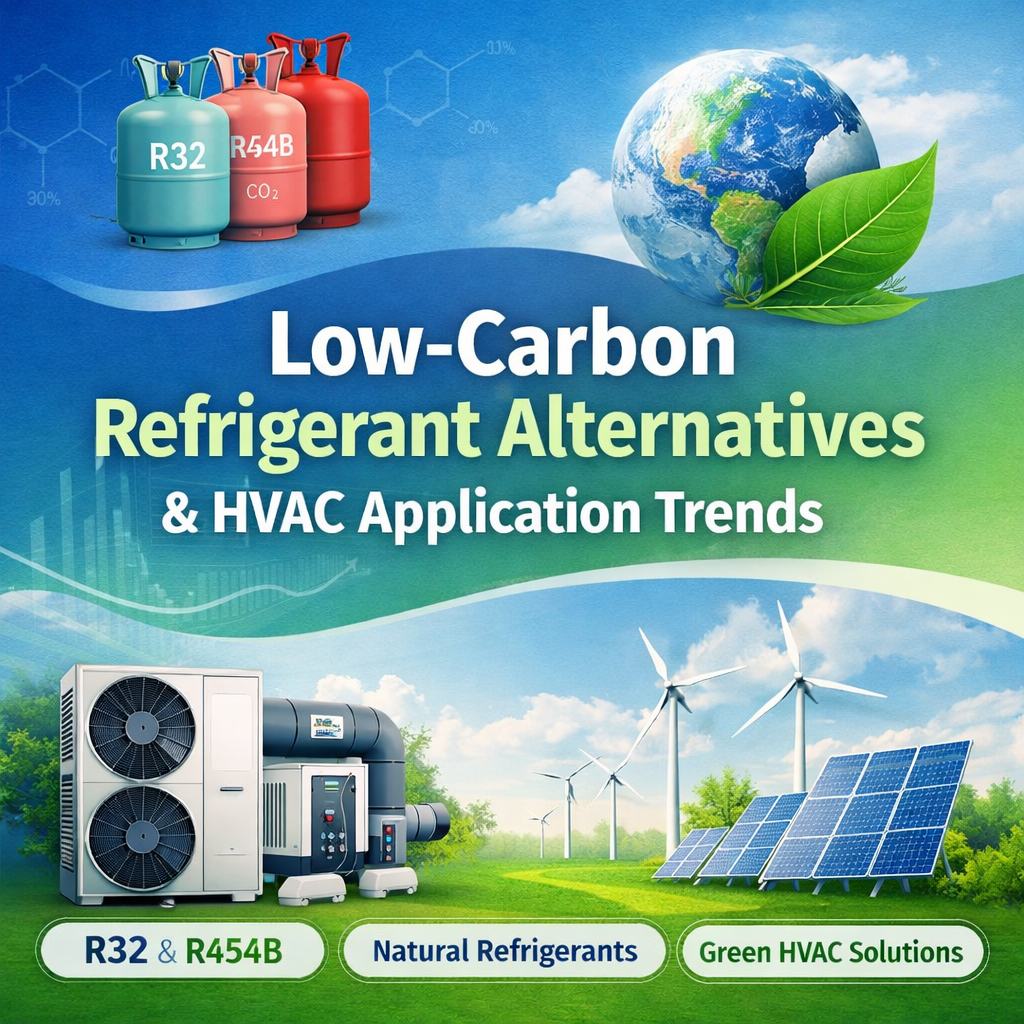
The HVAC industry is undergoing one of the most significant technological transitions in decades: the shift toward low-carbon refrigerants. Traditional hydrofluorocarbon (HFC) refrigerants such as R-410A have been widely used for years, but their high Global Warming Potential (GWP) has raised environmental concerns. As global climate policies tighten, governments and industry organizations are accelerating the phase-down of high-GWP refrigerants.
For example, regulatory frameworks inspired by the Kigali Amendment and regional policies now require new HVAC equipment to adopt refrigerants with significantly lower GWP values. Many markets are moving toward a GWP limit of around 700 for new air-conditioning systems, pushing manufacturers to redesign products around more sustainable refrigerant options.
This transition is reshaping system design, safety standards, and HVAC technology development. Understanding low-carbon refrigerant alternatives and their application trends is therefore critical for manufacturers, contractors, and building owners.
Why Low-Carbon Refrigerants Matter
Refrigerants play a crucial role in the refrigeration cycle, but many traditional refrigerants contribute significantly to greenhouse gas emissions when released into the atmosphere.
For example, R-410A has a global warming potential (GWP) of approximately 2088, meaning it absorbs more than 2000 times the heat of carbon dioxide over 100 years. In contrast, modern alternative refrigerants such as R-32 have a GWP of approximately 675, significantly reducing their environmental impact while maintaining high refrigeration efficiency.
The benefits of using low-GWP refrigerants include:
● Reduced greenhouse gas emissions
● Compliance with global environmental regulations
● Improved system efficiency and sustainability
● Maintaining long-term cost stability as regulations evolve
Therefore, the HVAC industry is rapidly adopting new refrigerants designed to balance efficiency, safety, and environmental performance.
Major Low-Carbon Refrigerant Alternatives
1. R-32 Refrigerant
R-32 has become one of the most widely used low Global Warming Potential (GWP) refrigerants in modern air conditioning systems.
Key advantages include:
● Lower GWP compared to conventional refrigerants
● High energy efficiency
● Single-component refrigerant, easier to recycle
● Lower refrigerant charge in some systems
Due to these advantages, R-32 is increasingly used in residential air conditioning, heat pump, and VRF systems. Many manufacturers consider it one of the primary refrigerant choices for next-generation HVAC equipment.
However, R-32 is classified as an A2L refrigerant, meaning it is slightly flammable. This necessitates updated safety standards, enhanced technician training, and improved leak detection systems.
2. R-454B Refrigerant
R-454B is another important low Global Warming Potential (GWP) refrigerant, designed specifically to replace R-410A.
Key characteristics include:
● GWP value of approximately 466, significantly lower than R-410A
● Operating pressure similar to R-410A
● Comparable or higher system efficiency
● Compatible with many existing HVAC designs
Many HVAC manufacturers have adopted R-454B as a direct replacement due to its good balance between performance, cost, and environmental impact. Some studies also indicate a slight improvement in system efficiency compared to R-410A systems.
Like R-32, R-454B is classified as a Group A2L refrigerant, requiring appropriate safety precautions.
3. Natural Refrigerants
Natural refrigerants are gaining attention due to their extremely low environmental impact.
Common examples include:
● R-744 (CO₂)
● R-717 (Ammonia)
● R-290 (Propane)
● R-600a (Isobutane)
Some natural refrigerants have extremely low GWP values—for example, R-290 has a GWP of about 3, making it one of the most environmentally friendly refrigerants available.
These refrigerants are increasingly used in:
● Commercial refrigeration
● Industrial cooling systems
● Heat pumps
● Data center cooling
However, certain natural refrigerants are flammable or toxic, which requires specialized equipment design and strict safety standards.
Application Trends in the HVAC Industry
1. Transition to A2L Refrigerants
A major trend in the HVAC industry is the widespread adoption of A2L refrigerants, including R-32 and R-454B.
Many countries now require newly manufactured HVAC equipment to use refrigerants with a Global Warming Potential (GWP) below certain limits, accelerating the transition to these alternative refrigerants. From 2026 onwards, many new commercial systems must meet stringent low GWP standards.
This shift is also driving innovation in the following areas:
● Refrigerant leak detection
● Ventilation and safety systems
● Technician training programs
2. Growth of Natural Refrigerant Technologies
Natural refrigerants are gaining traction in commercial and industrial applications, especially in regions with strict environmental regulations such as Europe.
Key growth areas include:
● CO₂ transcritical refrigeration systems
● Propane heat pumps
● Ammonia industrial refrigeration
These systems offer excellent environmental performance and are increasingly supported by advances in system safety and engineering.
3. Integration with High-Efficiency HVAC Systems
Low-carbon refrigerants are being integrated into advanced HVAC technologies, including:
● Inverter compressors
● Heat pump systems
● Smart energy management platforms
● Electrified hydraulic systems
This integration helps improve system efficiency while reducing building carbon emissions.
4. Regulatory-Driven Innovation
Government regulations are one of the strongest drivers of refrigerant innovation. Policies aiming to reduce HFC consumption by up to 85% by 2036 are pushing manufacturers to accelerate research and development of next-generation refrigerants.
As regulations continue to evolve, manufacturers must design flexible systems that can adapt to future refrigerant requirements.
Challenges in the Refrigerant Transition
While low global warming potential (GWP) refrigerants offer significant environmental benefits, the transition also presents numerous challenges:
● Safety considerations: A2L refrigerants require new installation and safety standards.
● Equipment redesign: Many systems must be redesigned to accommodate the new refrigerant properties.
● Training requirements: Technicians must learn updated operating and installation procedures.
● Supply chain adjustments: Manufacturers must ensure a stable supply and compatibility of components.
Addressing these challenges is crucial for ensuring a smooth transition for the HVAC industry.
Conclusion
The transition to low-carbon refrigerants marks a new era for the HVAC industry. As global climate policies drive the phase-down of high-GWP refrigerants, alternatives such as R-32, R-454B, and natural refrigerants are becoming the foundation of modern cooling technology.
Looking ahead, the future of refrigeration will be defined by higher efficiency, lower environmental impact, and smarter HVAC systems. Companies that embrace low-GWP refrigerants and invest in sustainable technologies will be well positioned to lead the next generation of energy-efficient cooling solutions.