Is water quality important for system performance?
- Share
- Issue Time
- Dec 19,2025
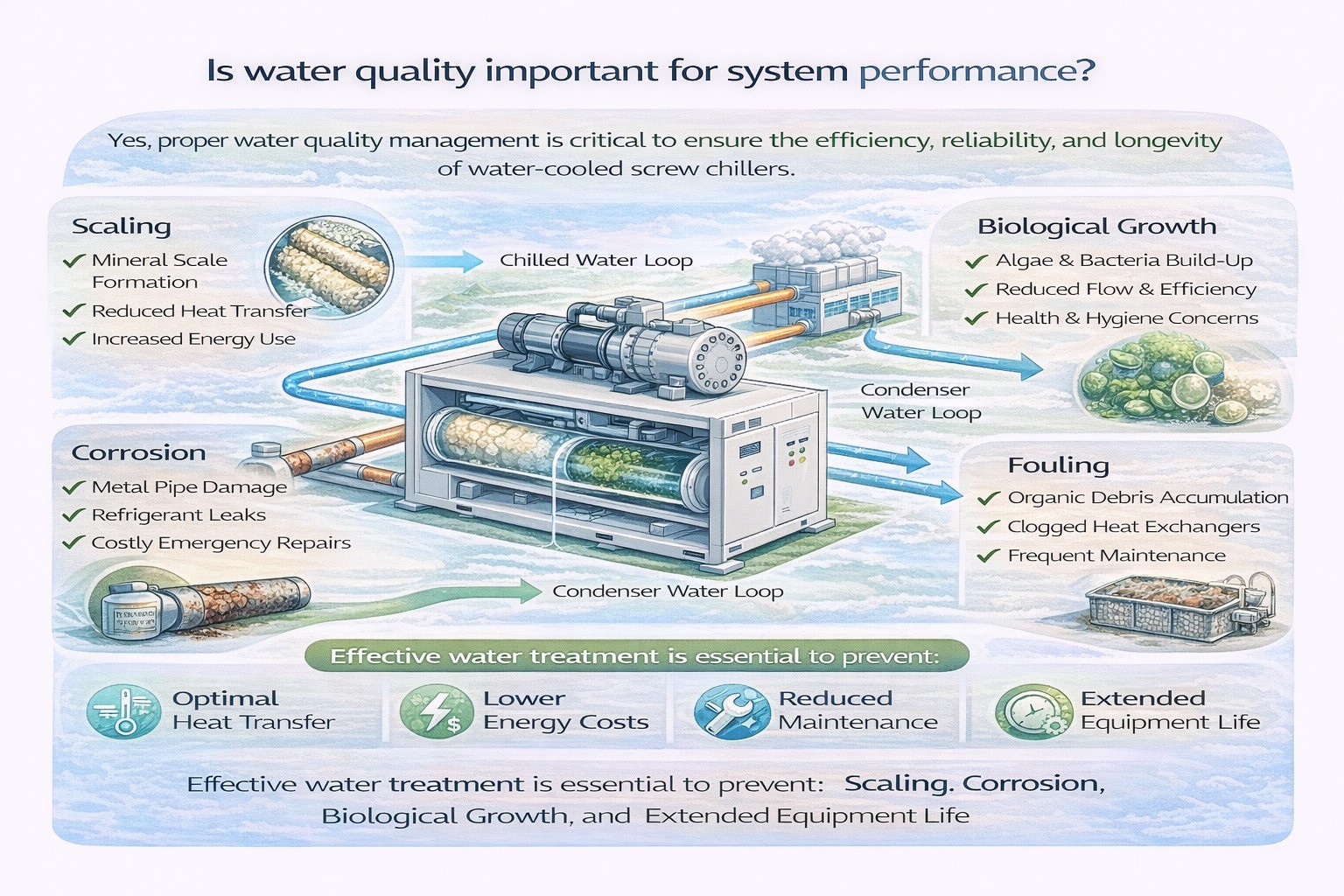
Yes, water quality is critically important for the performance, efficiency, reliability, and service life of a water-cooled screw chiller system.
In water-cooled HVAC systems—especially high-capacity, long-running equipment such as Aurashu water-cooled screw chillers—water quality directly affects heat transfer efficiency, operating stability, maintenance frequency, and overall lifecycle cost.
1. Why water quality matters in water-cooled chillers
A water-cooled screw chiller relies on two major water circuits:
Chilled water loop (supplying cooling to terminals or processes)
Condenser water loop (rejecting heat via cooling tower)
In both circuits, water flows continuously through heat exchangers, pipes, valves, and pumps. Poor water quality can lead to scaling, corrosion, fouling, and biological growth, all of which reduce system performance and may cause serious equipment damage over time.
Aurashu designs its water-cooled screw chillers for high-efficiency and long-term industrial operation, but even the most robust equipment requires properly managed water conditions to perform at its full potential.
2. Impact of poor water quality on system performance
(1) Reduced heat transfer efficiency
Scale deposits (calcium carbonate, magnesium salts) form insulating layers on heat exchanger tubes
Even a thin layer of scale can significantly reduce heat transfer
Chiller must run longer or at higher load → increased energy consumption
In Aurashu chillers, precision-machined shell-and-tube heat exchangers are designed for optimal thermal performance, but scale buildup directly offsets these advantages.
(2) Increased energy consumption
Fouled heat exchangers raise condensing temperature
Compressor power increases to maintain cooling capacity
System COP (Coefficient of Performance) declines
Over long operating periods, poor water quality can increase annual energy costs by 10–30% or more.
(3) Corrosion and equipment damage
Improper pH, high dissolved oxygen, or aggressive ions (chlorides, sulfates) accelerate corrosion
Corrosion can cause:
Tube leakage
Reduced pressure resistance
Refrigerant contamination
Premature heat exchanger failure
Aurashu offers optional anti-corrosion materials, tube coatings, and water-side protection designs, but correct water treatment remains essential.
(4) Biological fouling and blockage
Algae, bacteria, and biofilm can form in untreated water systems
Biofouling reduces flow area and heat exchange efficiency
Can cause unpleasant odors, hygiene issues, and system instability
This is especially critical in cooling tower condenser water systems.
3. Key water quality parameters to control
Aurashu recommends managing water quality according to industry standards and project-specific requirements, typically including:
pH value (usually 6.5–8.5)
Hardness (calcium & magnesium content)
Total dissolved solids (TDS)
Chloride and sulfate concentration
Dissolved oxygen
Microbial content
Suspended solids
Maintaining these parameters within acceptable limits ensures stable chiller operation and extends service life.
4. Aurashu design features supporting water quality management
Aurashu water-cooled screw chillers are engineered with water quality considerations in mind:
High-quality shell-and-tube heat exchangers
Optimized tube velocity to reduce fouling risk
Optional cupronickel, stainless steel, or enhanced copper tubes
Intelligent control system with temperature and pressure monitoring
Compatibility with standard water treatment and filtration systems
However, equipment design alone cannot replace proper water treatment.
5. Recommended water treatment solutions
For optimal long-term performance, Aurashu strongly recommends the following measures:
Water softening (to reduce scale formation)
Chemical water treatment (corrosion inhibitors, biocides)
Side-stream filtration (to remove suspended solids)
Automatic blowdown systems (for cooling towers)
Regular water quality testing and reporting
These measures significantly reduce maintenance costs and unplanned downtime.
6. Impact on maintenance and lifecycle cost
Good water quality results in:
Longer heat exchanger life
Fewer tube cleanings
Reduced compressor stress
Stable capacity output
Lower total cost of ownership (TCO)
Poor water quality, by contrast, often leads to:
Frequent shutdowns
Emergency repairs
Reduced system reliability
Shortened equipment lifespan
For large commercial buildings, industrial plants, data centers, and hospitals using Aurashu chillers, water quality management is a critical operational strategy, not an optional extra.
7. Aurashu service support and guidance
Aurashu provides:
Water quality guidelines during project design
Coordination with EPC contractors and water treatment suppliers
Custom material selection for special water conditions
Operation & maintenance recommendations tailored to local water quality
This ensures that each chiller system delivers stable, efficient, and reliable performance throughout its lifecycle.