What Is the Difference Between Falling Film and Flooded Evaporators?
- Share
- Issue Time
- Dec 24,2025
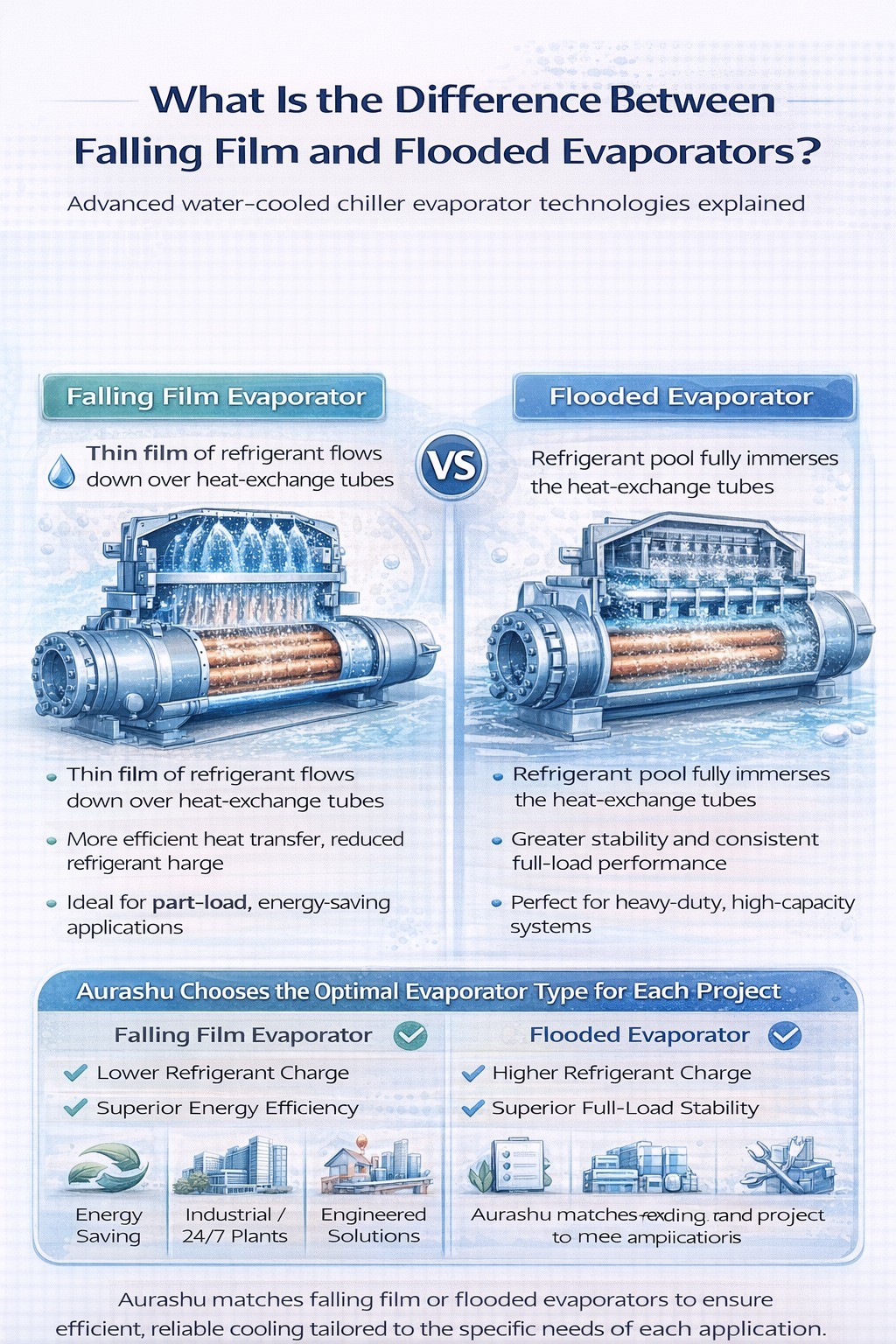
Falling film and flooded evaporators are two advanced heat-exchange designs widely used in high-efficiency water-cooled chillers, especially in large-capacity systems such as Aurashu’s falling-film and flooded water-cooled chiller series. Although both serve the same function—extracting heat from chilled water by evaporating refrigerant—they operate in fundamentally different ways and offer unique advantages for various applications.
A falling film evaporator distributes refrigerant as a thin, uniform liquid film over the outer surface of the heat-exchange tubes. The refrigerant evaporates almost instantly due to the large surface contact area, resulting in rapid heat absorption, reduced refrigerant charge, and lower energy consumption. Its high heat-transfer coefficient enables excellent part-load efficiency, making it especially suitable for projects requiring energy savings, compact structure, and fast response. Because only a small refrigerant volume is needed, falling film evaporators are often considered more environmentally friendly and cost-efficient in large HVAC systems. In addition, improved oil return, reduced pressure drop, and easier maintenance further enhance system stability.
In contrast, a flooded evaporator submerges the heat-exchange tube bundle in a refrigerant pool. As warm water flows inside the tubes, the surrounding refrigerant absorbs heat and boils. Flooded systems maintain a very high wetted surface area, delivering consistent and stable heat transfer under full-load conditions. This design is widely used in high-capacity industrial and commercial chillers requiring exceptional reliability, smooth operation, and long-term durability. Flooded chillers typically operate with higher refrigerant quantities, but they deliver superior thermal performance, particularly when load demands remain steady or when the chiller is part of a centralized plant that prioritizes constant high output.
Comparing the two, falling film evaporators offer lower refrigerant charge, superior part-load performance, and higher energy efficiency, making them ideal for green buildings, premium commercial facilities, and projects seeking long-term energy cost reduction. Flooded evaporators excel in large, steady-load environments, such as industrial cooling, process plants, data centers, and district energy systems. Falling film systems are more compact with faster heat-exchange response, while flooded systems are favored for their robustness, stable operation, and strong full-load capacity.
Aurashu applies both technologies depending on project requirements. For customers prioritizing energy efficiency and environmental sustainability, Aurashu’s falling film chillers provide excellent seasonal performance, reduced operating cost, and modular optimization. For heavy-duty, continuous operation environments, Aurashu’s flooded chillers deliver unmatched reliability, stable cooling output, and long service life.